What an independent perfumer’s fragrance really means
There is no official category for the independent perfumer. No regulation says when a perfume becomes an independent perfumer’s work, so the idea rests on practice. Someone, whether a perfumer, a creative director or a founder, makes recognisable olfactory choices, signs them and stands behind them, instead of following a market study. That is what separates a personal fragrance from a mass-market launch designed to please everyone at the first spray.
The phrase independent perfumer is slippery. It can describe the perfumer who composes the formula, the person who commissions it and steers its mood, much as a publisher does for a book, or a couturier whose name became the name of the house. Knowing which of these three you are dealing with changes how you read a label, because the signature of the hand that composes is not the signature of the eye that selects.
Enthusiasts often speak of author perfumery to stress ownership of the work: a name, a point of view and some coherence from one creation to the next. People who follow indie perfume brands usually look for a style of writing rather than a flattering smell, much as a film lover follows a director.
Frédéric Malle’s Editions de Parfums: a publisher and his perfumers
The clearest model of perfumer-led houses, where the perfumer’s vision comes first, is the one Frédéric Malle launched in 2000, according to the trade press. He acted as an editor. He did not compose himself: he gave each project to a perfumer with wide creative freedom and had that perfumer’s name printed on the bottle and the box. The brand’s official website describes its fragrances as works signed by the world’s greatest perfumers.
Here the independent perfumer is named and visible. The house’s product pages credit Portrait of a Lady to Dominique Ropion, Musc Ravageur to Maurice Roucel and Northern Love to Bruno Jovanovic. For a shopper this is practical. Once you know the perfumer, you can follow that writing into other houses and compare two works instead of judging a whole career from one bottle.
The story also shows that a signature is never fixed. Estée Lauder acquired the company in 2015, and Malle announced in April 2024 that he would leave the brand by the end of June 2024. A perfume can outlive its founder, so it is worth checking who runs the house today rather than relying on the founding legend.
Francis Kurkdjian: from perfumer for hire to a house with his name
Francis Kurkdjian, an independent perfumer in spirit if no longer in ownership, was born in 1969 and, according to his biography, created Le Male for Jean Paul Gaultier in 1995 at the age of 26. In 2009 he co-founded Maison Francis Kurkdjian with Marc Chaya, near Place Vendôme in Paris. LVMH bought the business in March 2017, and in October 2021 Christian Dior appointed him creative director of perfume, a role that Dior’s own website confirms.
His path is a common one among perfumer-led houses. A perfumer may work under his own name and for other houses at the same time, which makes independence less clear-cut than it sounds. The signature on the label tells you nothing about the shareholder.
Discovery sets as a way into a style
The house runs a page of discovery sets that listed seventeen items when we read it, from small 2 ml vials to larger 11 ml bottles. Sets like these let you cover a whole signature without committing to a full-size flacon. Contents and prices change, so check them with the retailer or the official page.
Reading a career instead of a reputation
Before you judge an independent perfumer, look at what he composed for others, what he signs under his own name and how the creations answer one another. A coherent career tells you more about taste than any advertising line.
Chanel Les Exclusifs: a personal tone inside a heritage house
A personal fragrance is not reserved for small companies. At Chanel the Les Exclusifs collection, whose official page names Gardénia, Coromandel, Sycomore, 31 Rue Cambon, 1932, Bois des Îles and Cuir de Russie among others, is presented as a set of subtle tributes to the history of Mademoiselle, Gabrielle Chanel. The page does not name any perfumer. The signature here belongs to the house and its founder, not to a nose.
The contrast with the publisher model is useful. At Malle the author is the perfumer and the name is printed. At Chanel the author is a historical world, that of a couturière. Both claim a perfumer’s vision, but they promise different experiences: one teaches you to follow a composer, the other invites you into the memory of a house.
Indie perfume brands and big groups: what ownership changes
Estée Lauder for Frédéric Malle in 2015, LVMH for Francis Kurkdjian in 2017: many houses once seen as indie perfume brands now sit inside large groups. That does not automatically alter the juice. It does mean that distribution, pricing, retail points and sometimes formats evolve, so compare a recent bottle with your memory rather than assuming it is identical.
A formula can also be adjusted for regulatory reasons, notably because the list of allergens in the European Union has changed over time, or because of raw-material supply. Author perfumery is not exempt from this: some fans say they notice differences from one batch to another. These impressions are subjective, and the house remains the only reliable source on its own changes.
How to spot perfumer-led houses in the shop: five signs
No single sign settles the matter, but several together point to an independent perfumer’s real approach, or at least to a house with a perfumer’s vision, rather than packaging. Look at what the brand gives you to read before you smell anything.
- The perfumer’s name appears on the bottle, the box or the official product sheet.
- The house explains each perfume’s starting point: a memory, a place or a material.
- Creations answer one another over the years instead of chasing the current trend.
- The adviser lets you smell several perfumes, not only the latest launch.
- Samples or a discovery set allow a trial before you buy a large bottle.
Testing with your own nose, not the name on the label
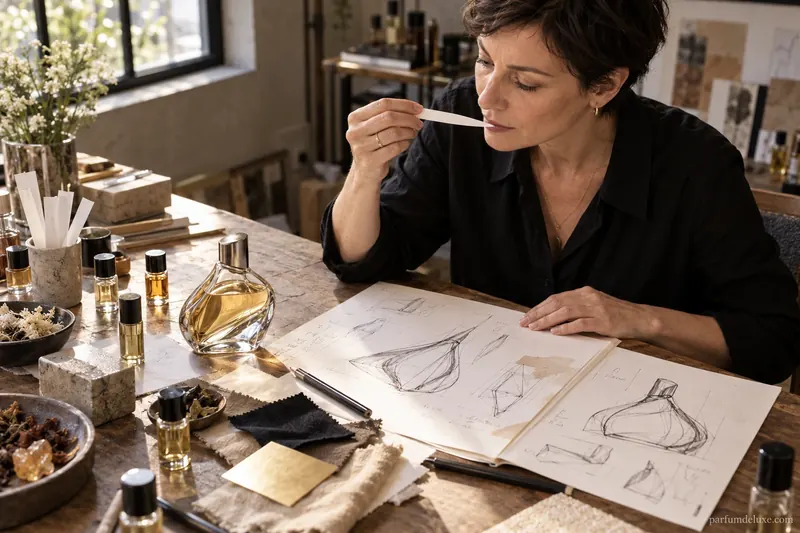
A famous name, a refined bottle or a limited release proves nothing about what you smell. Start with one to three scents on paper strips, keep the ones that hold your attention, then apply a single one to skin. Let it develop for several hours: the top notes fade and the base is what will really stay with you. Come back the next day to confirm the interest.
Many testers describe an independent perfumer’s fragrance as puzzling at first and coherent after a few hours on skin. That is an impression, not a rule. Set an expressive floral against a stripped-back woody scent and keep the one that triggers a precise emotion, whatever the reputation of the creator.
As with any fragrance, an allergy is possible. Try a small patch of skin, read the allergen list on the packaging and ask a health professional if you have doubts about your skin. Finally, buy from the house or a recognised retailer: counterfeits of sought-after bottles exist, are illegal and may contain uncontrolled ingredients.