What makes a luxury perfume for men
The word luxury is neither a standard nor a label. It points to a set of clues: a house that controls its manufacturing, carefully chosen materials, a refined bottle and box, and tightly managed distribution. None of these guarantees that you will like the scent, and a high price says nothing about the pleasure of wearing it.
For a luxury perfume for men, the essentials lie elsewhere: how cleanly the top, heart and base follow one another, how much room is left for the skin, and how the composition develops over several hours. A scent that stays the same from first to last minute can win through clarity; another that changes a lot will please those who like progression. Neither route is better than the other.
The main families of luxury fragrances for men
Perfumers sort creations into families. On the masculine side the usual ones are woody, aquatic, fougère, aromatic, spicy amber, leather, oud-based oriental and vanilla-woody. Each has its codes, but the borders move: one creation can be aromatic, amber and woody at once.
It is better to start from what you enjoy smelling in daily life: cut wood, crushed herbs, sea air, tobacco, saddle leather. That mental picture guides you, when choosing luxury fragrances for men, better than the labels sport, classic or evening, which are often too vague to steer a choice.
Woody styles: cedar, sandalwood and vetiver
Terre d'Hermès, created in 2006 by Jean-Claude Ellena, combines orange, grapefruit, pepper, patchouli, cedar, vetiver and benzoin. Hermès describes it as woody and mineral. Diptyque's Tam Dao sits at the other end, built around sandalwood, cedar, cypress and coriander. Two woody scents, two very different textures.
Aquatic styles: sea air rebuilt
The aquatic family owes much to calone, a molecule discovered by Pfizer in 1966 and used in perfumery since the 1980s, which suggests a sea breeze. Armani's Acqua di Giò, created in 1996 by Alberto Morillas, is among the best-known examples, with Calabrian bergamot, neroli, citrus and rosemary.
Fougère and aromatic styles: the barbershop legacy
The fougère takes its name from Fougère Royale, composed in 1882 by Paul Parquet for Houbigant around lavender, oakmoss and coumarin. That fresh, herbal structure has fed generations of masculine fragrances, down to today's aromatic creations.
Bleu de Chanel and how to read concentrations
Bleu de Chanel, released on 13 September 2010 as an eau de toilette, was created by Jacques Polge; his son Olivier Polge later formulated the 2018 parfum. Chanel places it among aromatic and amber scents with a woody trail, and now offers it as an eau de toilette, an eau de parfum and a parfum.
Among luxury perfumes for men, it is a good way to see that concentration changes the sensation without changing the name. A higher concentration generally brings more depth and staying power, not necessarily a more pleasant result: some people prefer the lightness of an eau de toilette. Always compare two concentrations of the same line on your own skin, and do not assume the richest will be the best fit.
Gentleman Society: a men's luxury perfume built on narcissus
Givenchy Beauty presents Gentleman Society as an eau de parfum in the woody, floral and aromatic families. The house lists sage and cardamom at the top, narcissus and vetiver at the heart, and cedarwood, sandalwood and vanilla in the base, with stated origins for the materials, such as sage from France, vetiver from Haiti, Uruguay and Madagascar, and vanilla from Madagascar.
This example shows that a luxury perfume for men is not necessarily virile in the conventional sense: a narcissus flower can sit beside a deep woody accord. Again, the published notes are the house's own, and the real result depends on skin, season and dose.
Tom Ford Private Blend: high-end cologne for men as a private collection
On the brand's website, Private Blend gathers creations of widely varied spirit: Oud Wood combines oud, exotic woods and amber; Tobacco Vanille blends tobacco, vanilla and sweet wood sap; Tuscan Leather suggests leather and warm spice; Ébène Fumé is a woody amber recalling palo santo; Neroli Portofino is a sparkling citrus amber.
That diversity is a reminder that a high-end cologne for men can move far from fresh, clean codes. This kind of men's luxury perfume speaks to those seeking a strong signature, and it asks for a longer trial than most, because tobacco, leather or oud accords do not suit every setting.
Matching luxury perfume for men to occasion and season
A luxury perfume for men meant for the office, the evening, summer or winter is not chosen by the same criteria. Heat amplifies accords; citrus and watery notes behave well in it, while amber woods and spices bloom in the cold. The same creation can seem discreet in January and heavy in August.
Luxury perfumes for men are also judged by their discretion. Think about those around you: a closed room, public transport or an open-plan office calls for more restraint. One to three well-placed sprays beat a cloud, whatever the price of the bottle.
Trying a luxury perfume for men with a method
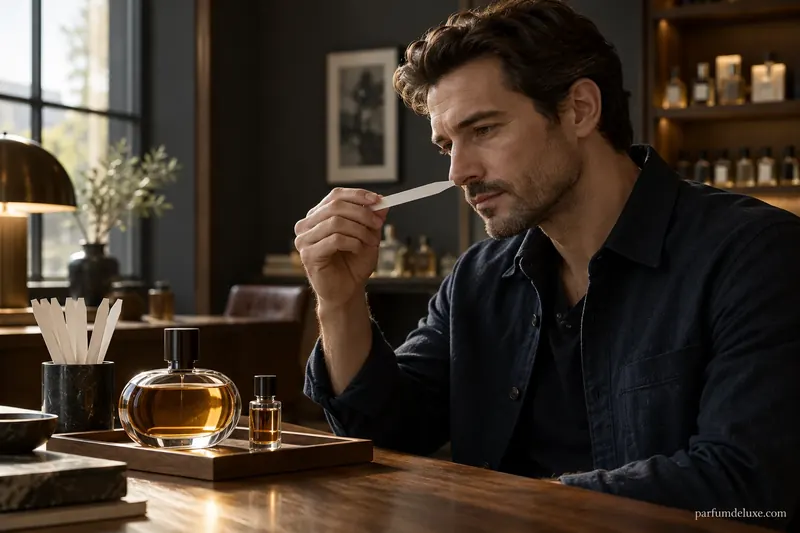
A luxury perfume for men is never judged on the first minute: the citrus or mint of the opening hides the central material. Spray on skin, wait half an hour, then return to the base at the end of the day. Chanel itself points out that scents are highly subjective, so your own perception outweighs reviews.
- Compare two or three creations from different families rather than three variants of one line.
- Note your impression after the opening fades, then when the base returns.
- Avoid testing more than three scents in one session, because the nose tires and everything starts to smell alike.
- Ask for samples or a small size before committing to a large bottle.
Authenticity, allergies and careful buying of luxury fragrances for men
Buy from the house itself or from a recognised retailer, and keep the receipt and the box: counterfeits are illegal and may contain uncontrolled substances. Be wary of prices far below the market, rough packaging or a missing batch code.
For the skin, regulated allergens appear on the label. Test a small area first, and see a health professional if you have reacted to scented products before. This precaution applies to every fragrance, including the most prestigious.