Why the quality of a perfume is never a single number
People often say a great perfume is an expensive one, or one that lasts all day. Neither claim survives scrutiny. Price also reflects the bottle, distribution, reputation and marketing; strength partly reflects concentration and the choice of highly diffusive molecules. These are clues, not proof.
It is fairer to separate two levels. The first is objective: what can be checked on a product sheet, a label or an official website, such as the ingredient list, the stated origin, whether refills exist or where it is made. The second is sensory: what you perceive on your own skin, day after day. Sound judgement uses both without turning a preference into a universal verdict.
Seen this way, luxury perfume quality is a set of questions rather than a score. Each one can be answered with evidence of a different kind, and the signs of a good perfume appear when several answers point the same way: a coherent construction, readable information, honest performance and a fair price.
Perfume quality criteria: five questions to ask in turn
To find your way, ask five successive questions. Is the construction coherent, balanced from the opening to the base? Are the materials identifiable and described? Does performance, wear time and diffusion, match what you expect for a specific use? Is the provenance documented and the bottle authentic? Is the price consistent with what you receive?
Each question calls for a different kind of evidence. The first is judged by nose, the second partly read in the house's documentation, the third measured on skin, the fourth checked with the retailer and the last compared with other perfumes. Mixing them in judging luxury perfume quality leads to shaky conclusions, such as believing that strong projection proves rare materials.
- Construction: coherence between opening, heart and base.
- Materials: identity, origin and description supplied by the house.
- Performance: wear time and diffusion suited to the intended use.
- Provenance: traceability of ingredients and authenticity of the bottle.
- Price: consistency between what is paid and what is received.
Materials and composition: what a product sheet can really say
Raw materials shape a perfume's identity, but merely naming one guarantees nothing. Take patchouli: according to dsm-firmenich, about 50 kilos of dry leaves are needed for one kilo of oil, and world tonka production is estimated at a few dozen tons a year. Those figures hint at the possible cost of a natural material without saying how much of it a perfume contains.
In luxury perfume quality, a good composition is recognised less by the rarity of its ingredients than by how they agree. Synthetic materials, often essential for stability, safety or batch consistency, can serve a great perfume. Conversely, a prestigious ingredient list does not rescue a muddled construction.
Ask also what the house says about the role of each material. A product sheet that explains why a note is present, and in which part of the perfume, is worth more than a long list of prestigious names with no context.
Longevity, sillage and projection: measuring without being impressed
Longevity is how long the perfume stays perceptible on skin; sillage is the trail it leaves in the air as you pass; projection is the distance at which others smell it. The three notions are distinct and hard to measure: they vary with skin, weather, place and even the sharpness of your nose that day.
High performance is neither a quality in itself nor a flaw. A shared office calls for restraint, a winter evening tolerates presence. For daily wear, comfort often matters more than power. No house can guarantee an exact duration, so the quality of a perfume does not depend on its volume.
How to judge a luxury perfume over time: a testing method
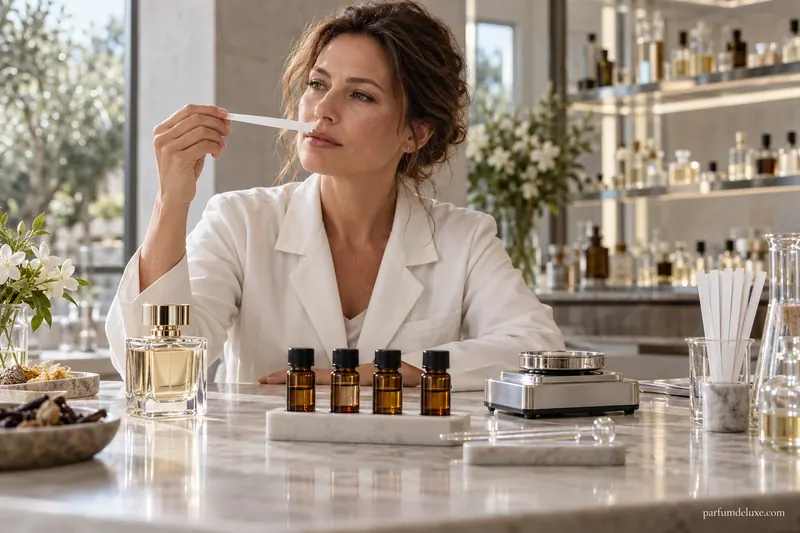
One pass on a blotter in a shop shows the opening, not the perfume. Work in stages: blotter to remove distractions, one touch on skin, then observations after an hour, four hours and the next morning. Write three words each time, without trying to isolate a material, to track how the accords evolve and whether the whole holds together.
Repeat the test two or three days in a row and in different conditions. If the perfume feels flat, harsh or artificial after an hour, that feeling counts even if the house is famous. To judge a luxury perfume, repetition beats first-day enthusiasm, which often skews comparison. To spot the signs of a good perfume, watch for a smooth evolution: late notes should logically extend the opening rather than seem to belong to another bottle.
A last precaution concerns memory. Smelling many perfumes in a row dulls your nose, so limit yourself to three or four per session and rest in between before drawing any conclusion on luxury perfume quality.
Traceability, transparency and ingredient lists
Several tools help document a perfume. Guerlain says it launched the Bee Respect platform in 2019, extended it to fragrance in 2021, and shows ingredient provenance, packaging components and manufacturing sites; since 2023 it has also belonged to the TRASCE consortium of 15 cosmetics players aiming to improve traceability of key components. Its text does not, however, quantify the share of ingredients traced.
The IFRA Transparency List, 2025 edition, records 3,312 fragrance ingredients and 379 functional ingredients, 3,691 in all including 1,021 natural complex substances. It is a worldwide inventory that names no companies, gives no volumes and is not a safety assessment. In Europe, regulation also extends labelling of fragrance allergens, with 81 substances to declare above set thresholds.
Authenticity and price: two safeguards for the quality of a perfume
A remarkable perfume loses all interest if it is counterfeit or badly stored. Before assessing the quality of a perfume, make sure you are buying from the house or a recognised retailer, and be wary of an unusually low price. Luxury perfume quality also depends on authenticity: counterfeits are illegal, may contain uncontrolled ingredients and can never offer a reliable point of comparison.
On price, compare bottles of the same concentration and size, and separate what belongs to the liquid from what belongs to the packaging. A high price may reflect real work on materials or, equally, positioning effort. Only comparing several perfumes, smelled under the same conditions, lets you decide.
The quality of a perfume for your own use: comfort, collection, refill
A good perfume depends on the project. For daily wear, look for tolerance, balance and ease of wearing. For a collection, originality, authorship and creative intent become central: Éditions de Parfums Frédéric Malle, for example, presents each fragrance as a work signed by a perfumer, such as Dominique Ropion for Portrait of a Lady or Maurice Roucel for Musc Ravageur.
Related services count too. Le Labo's refill programme lets you refill a 50 or 100 ml bottle with the same scent at about 20 percent below catalogue price, with a label showing the refill date. That kind of commitment does not improve the liquid, but it says a lot about how a house thinks about the life of its products.
In the end, luxury perfume quality is defined against your own priorities and not against a league table. Cross these perfume quality criteria with your own experience, then let time decide: what still pleases you after several weeks usually deserves its place.