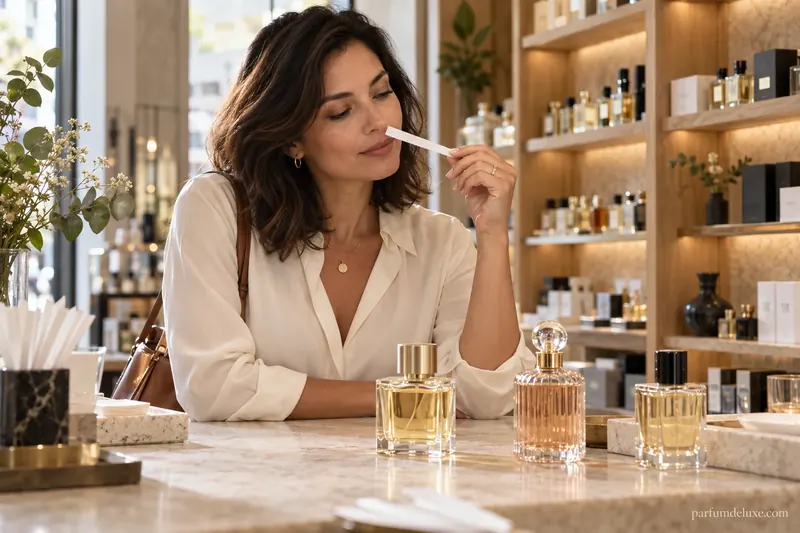
Perfume shops by city: what a local search really means
Typing a city name next to the word perfumery does not say what you are after. Some people want a large retailer to compare dozens of brands; others want a niche boutique for a rarely distributed signature; others want a workshop where they can blend their own scent, or a museum that explains how perfume is made. Separating those aims before leaving saves disappointment, and it also tells you how many shops are worth visiting in a single day.
Perfume shops by city fall into a few broad types: national chains found in nearly every large town, department stores in capitals, single-house boutiques, independent shops with tight selections, and workshops or museums rooted in a perfume region. One city may hold several of these, at very different walking distances.
Perfume shops by country: distribution is not the same everywhere
Perfume shops by country do not resemble each other. Distribution differs, and so do the brands stocked, the bottle sizes sold and the services. In France, selective perfumery leans on large networks and on heavily visited Paris stores; in Switzerland, big retailers sit beside a few haute parfumerie addresses; in Belgium, independent Brussels shops champion author-led selections.
A brand sold in one country is not necessarily available everywhere in it, or in every reference. Prices, sizes and editions can also change from one border to the next. Confirm the exact reference with the shop before the trip, rather than assuming that a whole catalogue is on the shelf.
Paris, Nice and Grasse: three ways to meet perfume in France
Among the perfume shops by city that draw the most visitors, Paris stands out. Galeries Lafayette Haussmann describes roughly 4,000 square metres of beauty space across three floors with more than 450 brands, including niche houses on the ground floor and haute parfumerie on the first. Jovoy on rue de Castiglione focuses on rare perfumes and offers scent consultations by appointment. Fragonard also runs a perfume museum in the capital.
In Nice, Molinard receives visitors at 20 rue Saint-François-de-Paule, where a perfumery expert guides the creation of a bespoke scent. The house lists four formats from a 45-minute discovery session to a two-hour prestige one, though which of them apply to Nice has to be checked with the house. Grasse hosts Galimard, founded in 1747, and Fragonard, with factory-museums and creation workshops.
Geneva and Switzerland: big retailers and haute parfumerie
Marionnaud says it runs close to 80 perfumeries in Switzerland, where it has been present since 2000. Manor offers an online perfume department with in-store pickup and counter advice. For something more confidential, Theodora Haute Parfumerie at Grand-Rue 38 in Geneva, active since 2005, describes itself as a niche perfumery devoted to rare scents.
Prices there are in Swiss francs, and purchases that cross the border raise customs and return questions. Check these points before you compare the figures on the tags, and ask each shop which formats and concentrations it keeps in stock.
Brussels and Belgium: a capital of author-led selections
Among Belgian perfume shops by city, Brussels offers contrasting examples. Smell Stories on rue des Teinturiers curates independent creators and hosts open scent tastings on the second Saturday of each month. Senteurs d’ailleurs receives clients at Place Stéphanie, with a second shop in Waterloo, a haute parfumerie offer and a sample box. Parfuma, a Belgian retailer, blends niche perfume and skincare.
Three shops, three personalities: catalogue size, advice and events all differ even inside one country. Write down opening times before you set out, because several boutiques close on Sundays or Mondays.
London, Dubai, Doha: looking beyond France
Abroad, department stores remain a sensible first stop. Selfridges in London lists more than 3,000 fragrance products online, with big brands and niche houses side by side. Penhaligon's, the British house, describes a refill service in selected stores.
Jovoy names boutiques in Paris, London, Dubai, Le Mans and Doha, a reminder that one perfumery can have several addresses under a single name. For any other city, from Montreal to Casablanca or Abidjan, the approach is identical: find the official stockists of the house you want and confirm stock before travelling.
How to find a perfumery you can rely on
To find a perfumery you can trust, whichever list of perfume shops by city you consult, start from the house itself, since its official site usually names its points of sale. Hermès, for example, provides a locator of more than 300 stores. Then confirm the address of the perfumery, the hours, any booking requirement and whether the exact reference is in stock. A phone call beats a wasted journey.
Prepare the visit too: three or four fragrances at most, a short list of notes you like or avoid, and plenty of time. Ask whether samples or minis are available so you can extend the test at home.
- Address and opening hours on the day
- Booking if the shop requires it
- Exact reference and size in stock
- Samples or minis available
- Return and delivery conditions
Perfumer's workshops and museums: another way to smell
A perfumer's workshop does not replace a trip to a perfume shop, but it teaches you to recognise materials. Galimard presents a Studio des Fragrances in Grasse where you compose a scent from 126 notes with an expert; Fragonard offers creation workshops in Paris and on the Côte d’Azur, plus several museums, including its perfume museums in Grasse and Paris.
These experiences suit curious travellers more than rushed buyers. Book ahead, ask for the exact duration and price, which depend on the formula, and remember that a blend made in a workshop is a personal creation, not a reference you can later find on a shelf.
Travelling home with perfume purchases
A bottle is a flammable liquid, and airlines and transport operators set rules for cabin and hold luggage. Ask them before departure, and check customs allowances if you cross a border, especially outside the European Union, as with Switzerland.
Keep the receipt, the original box and, if you can, a photo of the batch code printed on the packaging. Those items make an exchange or an authenticity check easier. Careful preparation leaves more time for what the trip is for: smelling and comparing, then going home to wear your shortlist for a few days before buying a full bottle.