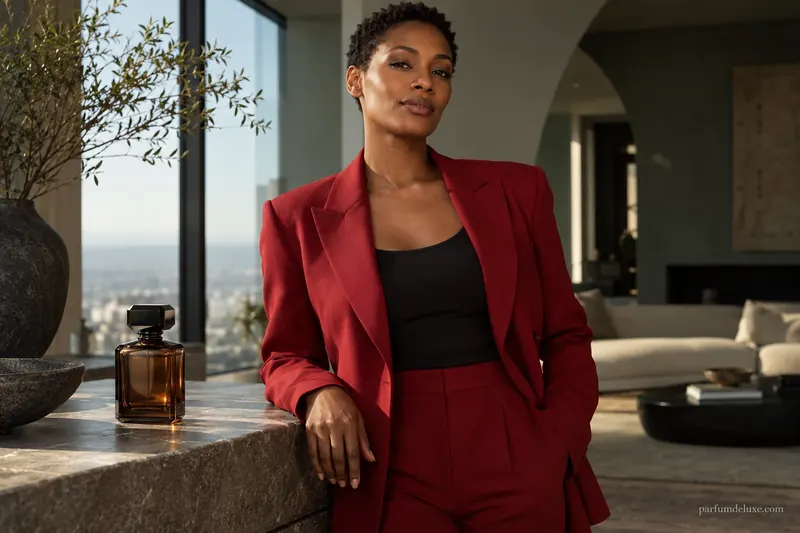
Luxury perfume in Tunisia: a market led by large retail chains
Searching for luxury perfume in Tunisia mostly leads to beauty retailers rather than single-brand boutiques. Two names stand out, Fatales and Point M. Both sell online, and Point M also runs a network of shops. The model resembles that of big European perfumeries: one aisle that gathers prestige houses, designer labels and more accessible lines.
There is a practical benefit. You can compare several houses in one place, with every price in the same currency, the Tunisian dinar. There is also a limit: a brand appearing in a catalogue says nothing about the depth of its range. A house may be listed with three eaux de toilette while its extraits or private collections are unavailable locally.
Before comparing anything, fix three reference points: the exact name of the fragrance, its concentration and the bottle size. Without those three details, two listings that look identical may describe different products.
Fatales, a perfume shop in Tunisia that sorts by concentration
The Fatales homepage presents perfume, makeup and skincare, with prices in dinars. In fragrance, shelves are split between women, men and children, with gift sets in each family. The site also separates product types: eau de parfum, eau de toilette, eau de cologne, eau de senteur and a line labelled simply Le Parfum. Candles, diffusers and testers appear too.
Its A-to-Z brand list includes prestige names such as Armani, Armani Privé, Bvlgari, Burberry, Cartier, Chanel, Chloé and Carolina Herrera, alongside makeup, skincare and haircare labels. Treat it as a starting directory, not a stock guarantee: a brand on the list is not necessarily available in every reference or every shop.
Fatales also promotes a selection called Les Xlusifs, made up of about thirty brands. Read it as a commercial showcase reflecting distribution agreements, not as a quality ranking.
Reading the listing before comparing prices
Compare at equal volume. A 50 ml and a 100 ml bottle from the same line have different costs per millilitre, and a gift set may include a travel size or a body product. Read the full product name as well: a near-identical title such as an intense or absolute version points to a different composition.
Point M: eleven stores and perfume advisers
Point M describes itself as one of the perfume shops in Tunisia, a beauty retailer founded in 2001, with its head office at Les Berges du Lac in Tunis and eleven stores according to its website. Its fragrance catalogue names houses such as Chanel, Dior, Guerlain, Hermès, Yves Saint Laurent, Giorgio Armani and Dolce & Gabbana, next to candles and home fragrances.
The chain advertises beauty advisers and a loyalty card. For perfume, that advice is most useful for testing on skin and comparing two or three scent families in a single visit. Ask to wear the fragrance for a while rather than judging it on a paper strip, because heart and base notes only appear with time.
The homepage does not detail delivery zones or lead times. If you plan to order luxury perfume in Tunisia remotely, check those conditions at checkout, along with the exchange policy.
How to buy perfume in Tunisia: checks that pay off
To buy perfume in Tunisia with a method, work in steps. Note the full fragrance name, concentration and volume. Then see whether the product is sold as a single bottle, a gift set or a tester, because those three presentations are not equivalent.
Testers, which Fatales files in a separate category, exist for trying a scent; their packaging is simplified and they are not meant as gifts. Promotions, frequent in beauty retail, deserve the same reflex: compare the price per millilitre before and after the discount instead of the advertised percentage.
If the perfume is a gift, ask what an exchange covers, since some retailers limit returns to unopened products. Engraving, personalisation or special wrapping are services to confirm before ordering, never to assume.
- Write down exact name, concentration and volume before comparing.
- Tell single bottle, gift set and tester apart.
- Compare price per millilitre, not only the announced discount.
- Wear it on skin and wait for the notes to develop.
- Confirm delivery and exchange terms.
Tunisian perfume heritage: the orange blossom of Cap Bon
When people mention Tunisian perfume, they rarely mean a world-famous luxury label. The country is above all a place of raw materials and floral customs. The Nabeul region, on Cap Bon, is known for the bitter orange tree, whose blossom is picked in March and April. According to a La Presse report published in March 2026, the region accounts for roughly 95 percent of national bitter orange blossom production.
The flowers, called zhar locally, are distilled in two ways. Large processing units extract neroli essential oil for perfumers. Families also distil at home, in a copper still topped with a clay pot, to obtain a scented water used in pastry and drinks.
The same report mentions other local distillates: orange leaves, rose petals, geranium and mint flowers. It is a culture of floral water before it is a culture of luxury bottles, which is why a hydrosol is easier to find than a local signature perfume.
Nabeul neroli: what can be said and what cannot
Nabeul neroli matters to luxury perfumery because the note, fresh, floral and faintly bitter, appears in many colognes and eaux de parfum. Tunisian press explains that several hundred kilograms of blossom are needed to obtain one litre of essential oil, which explains the value of the material.
Caution is needed, though. One La Presse article says the Guerlain perfumer Thierry Wasser reportedly uses neroli from Nabeul orchards. That is a press statement, not a technical sheet from the house, so no one can conclude that a given bottle contains Tunisian neroli.
Harvest volumes change from year to year and from source to source. Two 2026 articles give very different orders of magnitude for the tonnage of blossom, so it is wiser to retain no isolated figure. Growers also mention labour costs, climate hazards and international competition.
Niche houses and designer labels: preparing a remote search
For luxury perfume in Tunisia, general retail catalogues mainly cover prestige houses and designer labels. For a niche house, whose distribution is deliberately limited, the offer in perfume shops in Tunisia is thinner and depends on agreements between the brand and its distributors. Not finding a confidential house on a mainstream shelf is therefore normal.
In that case, start with the house’s official website, which lists authorised retailers by country, then compare shipping fees, possible import duties and return terms. A price far below an authorised seller’s should raise doubts about the product’s origin: counterfeits and untraceable goods exist, and they are both illegal and risky.
Finally, ask for samples. An expensive fragrance is judged over several days of wear, and a few millilitres cost far less than a bottle that does not suit you.
Trying, gifting and storing: the habits that matter
For luxury perfume in Tunisia, hot summers affect longevity and projection. A cologne or an eau de toilette built on citrus tends to feel more pleasant in the heat than a very rich extrait, which can seem heavy. Test in the season in which you will wear the fragrance.
For storage, avoid direct light and heat, especially in a car or beside a window, because these conditions damage the top notes. A bottle kept in its box, out of the sun, holds its nuances better.
On safety, perfumes contain substances that can trigger reactions in some people. If in doubt, try a small patch of skin and read the ingredient list; for any reaction, ask a health professional.