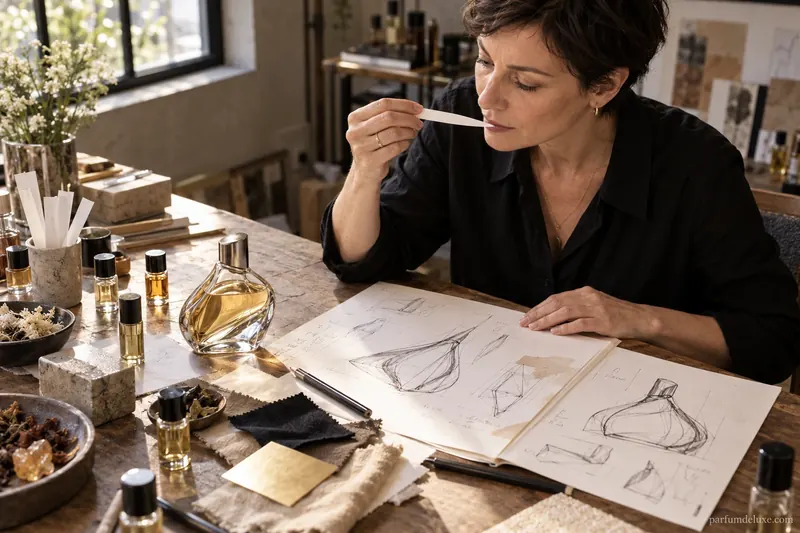
What does a perfumer do? From brief to formula
Most projects begin with a brief. A brand describes an intention and an audience, sometimes an ingredient to showcase or an existing scent to move away from. The perfumer, popularly called the “nose”, turns that request into a formula: proportions of natural materials and synthetic molecules.
One encyclopedic summary puts the rest neatly: the nose blends several mixtures from the client’s brief and often revises the formula before sale. In other words, the perfumer career is a sequence of trials, feedback and corrections far more than a single flash of inspiration.
A typical project therefore involves several people with distinct roles: the perfumer who writes the formula, an evaluator who judges each trial against the brief, the brand team that decides whether the direction fits its identity, and technical specialists who check that the result can be produced and sold. The perfumer’s skill lies as much in listening to those voices as in composing.
Memory and vocabulary: what learning how to become a perfumer demands
The perfumer’s job rests first on memory. You must recognise hundreds of materials, retain their nuances from one harvest to the next and anticipate how they behave together: a wood can pull a floral toward smoke, a lemony note can fade next to a resin.
That memory is trained like an instrument, which is why how to become a perfumer is largely a question of daily practice. At ISIPCA, the school’s management compares the discipline needed to that of musicians and athletes, and graduates of the formulation track learn to identify 350 raw materials. Professional vocabulary has to be learned too: accord, absolute, base, sillage are precise terms for laboratory teams.
How to become a perfumer: the ISIPCA route in Versailles
One of the best-known routes runs through ISIPCA in Versailles, founded in 1970 by perfumer Jean-Jacques Guerlain. The school enrols more than 500 students, classes of no more than 20 to 25, and most programmes are work-study, with over half the training time spent in companies.
Entry is selective: about one applicant in four is admitted across all programmes, and about one in ten for the professional master’s in formulation and sensory evaluation. What does a perfumer do after graduating? Often a long apprenticeship, as the next section shows. Another one-year programme, Fragrance Expertise, Formulation & Applications, targets candidates at Bac+5 level and covers the chain from brief to market launch, with a six-month internship or first job.
A heavily scientific perfumery school
Students choose ingredients and a method, which involves a good deal of physics and chemistry. According to a magazine report on the school, applicants often hold a chemistry degree, and following industry news counts toward admission.
A second perfumery school: Grasse
In Grasse, the Grasse Institute of Perfumery offers an international technical degree in fragrance creation and sensory evaluation, taught in English. The course lasts eighteen months, or 1,200 hours, 600 of them taught by accredited perfumers or technical experts and 600 of supervised practice and visits to factories, laboratories and growers, followed by a six-month internship.
The programme covers natural and synthetic materials, classification of fragrance families, accord building, olfactory imitation, regulation and analytical techniques such as gas chromatography. This perfumery school is designed for candidates who already have experience: the institute prefers a Master’s in sciences or marketing, with a Bachelor’s as the minimum, and some time in the industry. Only twelve students are selected, after a half-day of calculation, creativity and odour-recognition tests, and an interview.
A perfumer career told first-hand: Christian Provenzano
Nothing beats a first-hand account of how to become a perfumer. In a conversation published by Penhaligon’s, Christian Provenzano says he started as a laboratory compounder at a Dutch fragrance company in Amsterdam. His supervisor noticed his nose and invited him into the company’s perfumery school; after about a year he became a trainee perfumer, then a junior perfumer.
Four years later a UK company hired him, and after eight years a competitor recruited him as senior perfumer. In 1989 CPL approached him; he has worked there for thirty years and now leads a team of thirty perfumers. His favourite Penhaligon’s creation is Halfeti. For its sequel, Halfeti Leather, he says he had to push the leather while keeping the two scents distinct, using CPL materials reserved for its own perfumers.
Master perfumer, fragrance house or independent: ways of working
A perfumer often works for several brands at once, inside a fragrance and flavour manufacturer or an independent company. Others are attached to a single house and sign for one name. Either way, the project brings together an evaluator, the brand team and technical specialists, and a master perfumer in such a team still answers to the brief like everyone else.
Material suppliers matter as well. Robertet, which claims more than 10,000 raw-material references and extracts made by several processes including CO2, makes its products available to creators. A newcomer asking how to become a perfumer should note this: the craft includes knowing where materials come from. Choosing a rare ingredient depends as much on such supply chains as on the perfumer’s taste. At a historic site such as Fragonard in Grasse, visitors can see the old perfumer’s laboratory and its organ-style cabinet of essences, a reminder of how materials were kept within reach. Anyone aiming at this perfumer career must learn to work in such a library of materials, long before a first personal formula.
Myths about how to become a perfumer, and ways to learn more
The first cliché about the work of a perfumer is the solitary artist guided by inspiration; the second is that a good nose is enough. In reality method, chemistry, regulation and the ability to hear a brief weigh as much as smell. The profession also demands patience, because a formula is often corrected several times before approval.
To explore without aiming at a career, workshops exist, and they answer the question of what a perfumer does with your own hands. Molinard says it has run creation workshops since 1994, where you blend with a graduated pipette under a perfumer-advisor’s guidance. That is not a perfumer’s training, and the answer to how to become a perfumer still runs through years of study and practice, yet a workshop shows what balancing an accord really means.