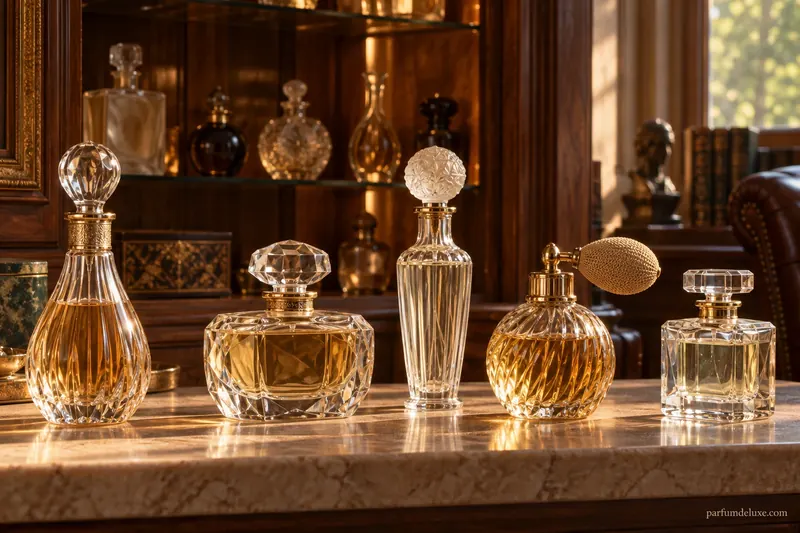
Why the word oriental confuses a search for oriental fragrances
In everyday speech, oriental points to an imagined East of spices, resins and vanilla rather than to any real region. Even the trade vocabulary has moved. On the fragrance wheel devised by Michael Edwards in 1992, this style formed the Oriental group, which the 2010 chart labels Amber, noting it was previously called Oriental.
For the reader, the consequence is practical. An oriental perfume is not automatically a Middle Eastern brand's perfume, and it does not have to contain oud. It is first of all a warm, enveloping sensation, found as readily in a Parisian classic as in a niche release.
Shop assistants and online descriptions often file oriental fragrances next to gourmand, woody and spicy ones with no clear border. A sharper vocabulary stops you from missing a bottle you would love or from buying a second copy of one you own.
The sub-families of amber perfume
In the 2010 version of the Edwards wheel, the Amber family splits into three branches: Soft Amber, which pairs incense with amber notes, Amber, which brings together oriental notes and resins, and Woody Amber, led by sandalwood and patchouli. The grid lets you describe a taste without reaching for the word oriental.
In practice an amber perfume can lean gourmand, dry and woody, powdery and floral, spicy or musky and close to the skin. Two bottles from the same family can feel opposite, which is why tasting them one by one beats browsing by label.
A practical test is to ask which of these branches your favourite perfume belongs to. If you love sweet vanilla, soft amber will probably suit you; if sandalwood and patchouli attract you, look at woody amber. Browsing oriental fragrances this way saves money and avoids disappointment.
Labdanum, benzoin, vanilla: what an amber accord holds
Perfumery amber is not one ingredient but a reconstructed accord, usually built on labdanum, benzoin and vanilla. Perfumers add opoponax, myrrh or frankincense, musks, woods such as sandalwood or cedar, and spices such as cinnamon or saffron as the brief requires.
Ambergris, an animal material, once served as the classic fixative. It is now nearly absent from formulas for ethical and cost reasons, and plant-based labdanum has taken over its role. Modern amber perfume also leans on synthetic molecules, which allow clearer, drier versions than the heavy ambers of the past.
Keep in mind that one word on a product sheet can cover very different things: amber here means a warm resinous accord, not fossil resin. Every luxury oriental fragrance reads that accord its own way, drier in one bottle, sweeter in another.
When reading notes, remember that ambery fragrances often list amber in the base and vanilla or tonka beside it, so a bottle described as amber may smell sweeter or drier than you expect. A good oriental perfume reveals this only after an hour or two on skin.
Grand Soir, an ambery evening fragrance
Maison Francis Kurkdjian files Grand Soir under the ambery and woody families and presents it as a fragrance to wear with your finery. According to the official sheet, it opens on an accord of cistus labdanum, lavandin and cinnamon leaf, and rests on an amber-vanilla base with benzoin facets. It is sold as an eau de parfum.
The description shows warmth built from resins and spice rather than from sugar. For anyone who prefers drier ambers, it is a handy reference point, though perception stays personal.
Reading such a sheet carefully also protects against vague promises. Words like intense, addictive or irresistible describe a mood, not a measurable property, and only a test on your own skin settles the question.
Opium and the spicy oriental perfume of 1977
Launched by Yves Saint Laurent in 1977, Opium is described by Wikipedia as a spicy oriental for women, composed by Jean Amic and Jean-Louis Sieuzac. The pyramid it quotes runs from mandarin, plum, clove and coriander at the top, through jasmine, rose, carnation and cinnamon in the heart, to sandalwood, myrrh, opoponax, labdanum, benzoin and amber in the base.
The name caused a stir on release, with critics accusing the brand of condoning drug use, yet the perfume became a best-seller. Opium reminds us that a classic oriental can be denser and spicier than many recent launches, so test the bottle sold today instead of relying on reputation.
Spiritueuse Double Vanille, the woody-ambery take on vanilla
Guerlain describes Spiritueuse Double Vanille, from its L'Art & la Matière collection, as a woody-ambery fragrance in which an excess of vanilla reveals its smoky, woody and generous side. Madagascan Vanilla planifolia is the central note, joined on the official page by jasmine, ylang ylang, benzoin, cedar, rum and spices. The house lists a high intensity and credits the composition to Jean-Paul Guerlain.
Set against the resinous Grand Soir and the spicy, floral Opium, it stands for the gourmand, woody route. One label, three profiles that are easy to tell apart at first sniff.
- Grand Soir: cistus labdanum, cinnamon leaf and an amber-vanilla base.
- Opium: spices, white flowers and resins, launched in 1977.
- Spiritueuse Double Vanille: Madagascan vanilla, rum, woods and spices.
Matching warm fragrances to season and setting
A warmth that is pleasant in small doses can become overwhelming in an office or a car. Many enthusiasts keep luxury oriental fragrances for evenings and cooler months, and use fewer sprays in summer. Wearing a sample for a whole day instead of a few minutes shows how the base develops.
Pay special attention to the base, because that is where your relationship with sweetness, woods and resinous nuances is decided. Read the base notes first, then ask for a sample before committing to a large bottle. That contrast is the quickest way to learn what you want from oriental fragrances.
Matching ambery fragrances to season and setting
Rich blends of spice, resin and vanilla can include ingredients that rank among the allergens declared on the label. Testing a small patch of skin before regular use is a sensible habit, though it does not replace advice from a health professional for reactive skin. Layering several warm products, a scented body cream plus a spray, can multiply the effect, so build gradually.
The most sought-after bottles are also the most copied. Buy from the brand or a recognised retailer, compare the bottle and batch code with the official product sheet, and be wary of unusually low prices: counterfeiting is illegal and puts uncontrolled products on your skin.